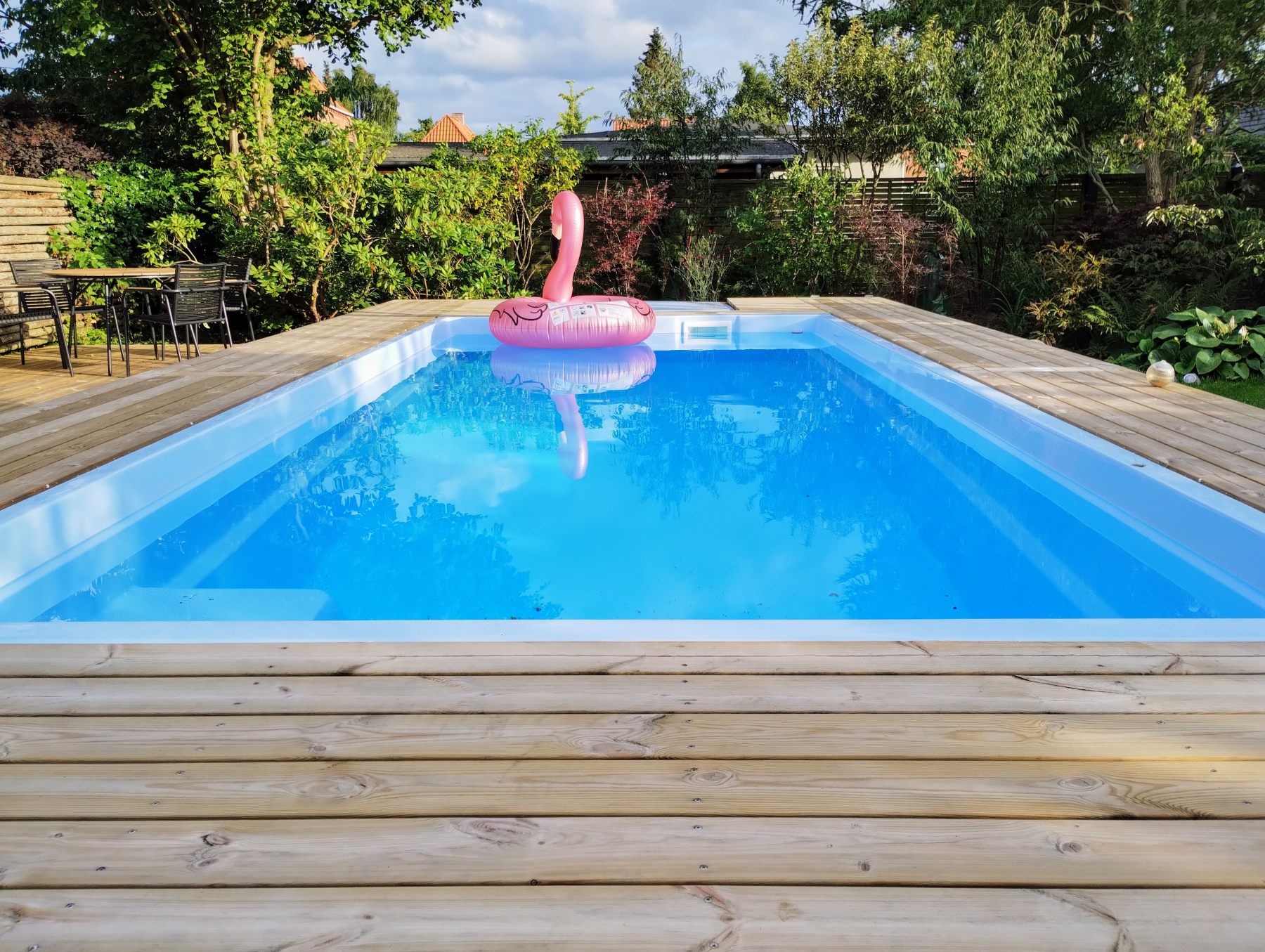
As a child I dreamed of a pool in the garden. Who didn't? I knew full well that we would probably never get one at my childhood home – and my dad's dry remark, "if you dig the hole yourself", stuck around as a kind of family phrase. A gentle no wrapped in an impossible condition.
But dreams have a way of waiting patiently. Now there is finally a finished pool in the garden at my own house. Getting here has been quite a journey – with research, permits, digging, concrete and a good deal of mud. Here is the story of how it happened.
"If you dig the hole yourself." – and that is nearly what we ended up doing.
The idea was born on holiday
We've spent a fair few holidays in Spain and France through home exchange, where two families swap houses. We've always had one firm requirement: there had to be a pool. On one of the trips, a so-called GRE pool stood in the middle of the lawn, and that was where the idea really took shape.
The pool sat on top of the lawn, so you avoided digging altogether. It was a "liner pool" with a timber frame around it and a plastic basin inside that you simply filled with water. Simple and yet neatly made, with wooden panels all the way around. Most of the pools we saw had a small wooden deck built around them, so you could sit right by the water. That image stayed with us.
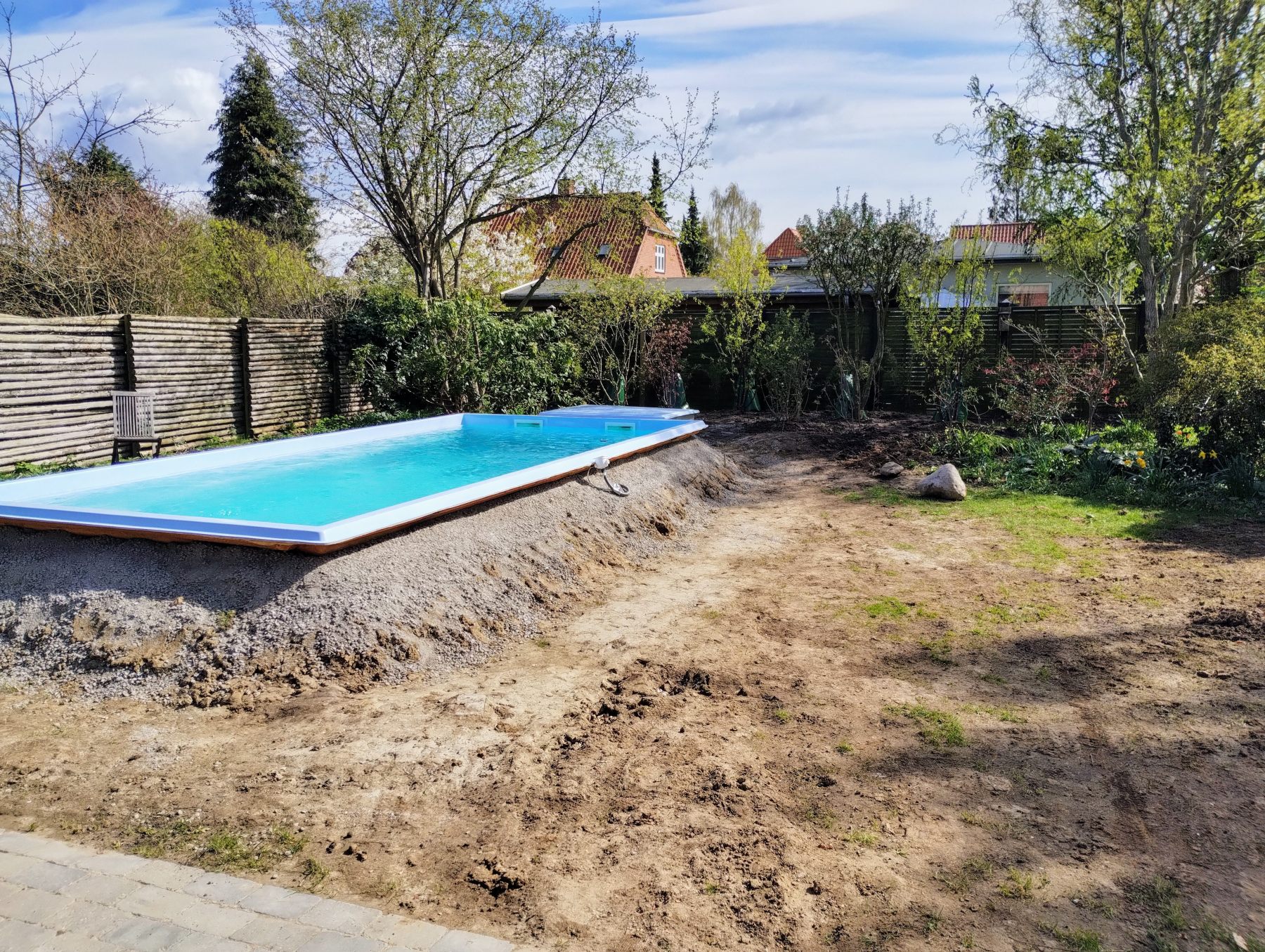
Back home, we started looking into what such a pool would cost. GRE is a French company, but similar pools are sold in Denmark too. The more we read, the clearer it became that we didn't want to settle for a pool on top of the lawn – we wanted it sunk in, level with the terrace, as a natural part of the garden.
Salt water or chlorine?
One of the first big choices was how the water should be kept clean. There are essentially two options: a chlorine pool or a salt-water pool.
Chlorine pool
The advantage of chlorine is that it's cheap. The downside is that chlorine smells slightly, and it can irritate skin and eyes.
Salt-water pool
A salt-water pool, on the other hand, doesn't smell, gives slightly better buoyancy in the water, and is gentler on both skin and eyes. For us the choice wasn't hard: it had to be salt water.
A salt-water pool uses a so-called chlorinator (salt-water unit). It may sound paradoxical, but a salt-water pool actually contains chlorine too – the difference is how the chlorine is made. The chlorinator uses the salt in the water and, through electrolysis, turns it into free chlorine that cleans the water. The chlorine is used up, turns back into salt, and the process repeats. So you avoid constantly adding chlorine – and the sharp chlorine smell.
From plan to hole in the ground
Once the choices were made, the big practical work began. A sunken pool isn't just a pool – it's a whole groundworks project with many stages that have to come together in the right order.
-
Measuring and planning
The pool was measured into the garden: 6.5 metres long, 3 metres wide and 1.5 metres deep. At the same time, the technical setup, the heating and the location of the equipment box had to be settled.
-
Clearing the garden
Room had to be made. A thuja hedge was felled and the roots ground out, a rhododendron and a hydrangea moved, and large amounts of soil shifted around the garden.
-
Digging the hole
Then came the excavator. A deep hole for the pool was dug out, and truckloads of soil carted away from the plot.
-
Casting the foundation
In the bottom of the hole, a solid concrete foundation was cast – several cubic metres of concrete, so the pool could stand perfectly level and stable.
-
The crane and the lowering
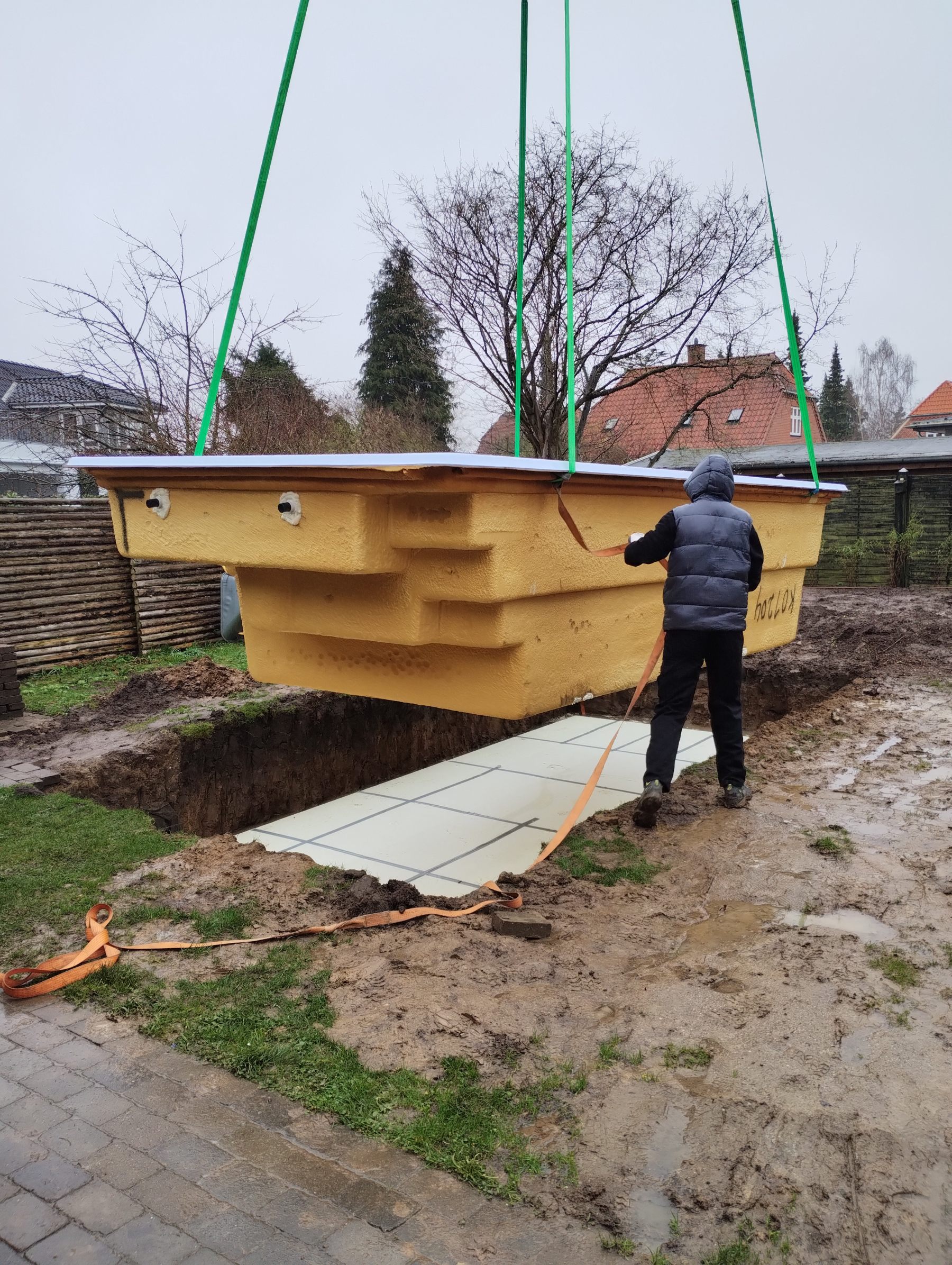
The big day: the pool was delivered and lifted into place by crane, in over the garden and carefully down into the hole.
-
Assembly, technics and power
The pool was installed, the filter and salt-water unit set up, and an electrician connected the pump and pool lights. It even needed a new electrical panel.
-
Wooden deck and planting
Finally, a wooden deck was built all the way around, and the garden was given new planting, so the pool came to sit as a natural centrepiece.
Everyday life with a pool
Today the pool is a fixed part of everyday life from early spring until well into autumn. An automatic cover can be rolled across the water and keeps in both the warmth and the cleanliness when the pool isn't in use. A pool robot handles most of the cleaning, and the salt-water unit keeps the water clear with a minimum of effort.
It became a bigger project than the boy who once dreamed of a pool could ever have imagined. But every time the sun hits the blue water between the wooden deck and the green garden, there's no doubt: it was worth every single spadeful.